
Home|Blog | An Uncommon Outcome From Breast Augmentation: Symmastia (Uniboob)
An Uncommon Outcome From Breast Augmentation: Symmastia (Uniboob)
Though the results from a breast augmentation are generally excellent with a satisfaction rate well over 90 percent, complications and less than desirable results do occur. One of the less common problems that can occur is where the breasts are so close together that they seem to coalesce into one breast unit. This is called symmastia (or synmastia) or in pseudo lay terms, a uniboob.
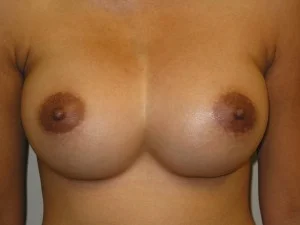
Symmastia of breasts
What are the causes of this deformity known as symmastia? Usually this is the result of attempting to move the breasts closer together in order to obtain improved cleavage. The pockets for the implants are dissected too far toward the midline which detaches the skin and underlying tissue from adhering to the sternum. The skin then drapes over the breast implants without having a discrete attachment to the sternum creating this amorphous “uniboob”. The situation is further exacerbated with implants that are inappropriately sized for the woman’s dimensions. Symmastia can occur both with breast implants placed in front of and behind the pectoralis major (chest wall) muscle.
Women who are very thin do have a slightly greater risk of this deformity occurring as do those who have a chest wall deformity known as pectus excavatum (where the sternum has a caved in appearance). Very conservative dissection in these situations and avoiding disproportionately large breast implants can help to minimize the development of symmastia.
There are several approaches which have been employed to address this challenging deformity. A relatively new technique involving the placement of specially processed tissue (Alloderm® and Strattice®) offer the potential of more predictable, satisfactory and permanent results.
For more information on symmastia, breast implants, breast augmentation or any other cosmetic surgery procedure or to schedule a consultation, you can call my office at 480-451-3000.
Steven H. Turkeltaub, M.D. P.C.
Scottsdale and Phoenix, Arizona