
Home|Blog | The Effects of Previous Unilateral Breast Radiation Treatments On Bilateral Breast Reconstruction Using Tissue Expanders
The Effects of Previous Unilateral Breast Radiation Treatments On Bilateral Breast Reconstruction Using Tissue Expanders
Women who undergo bilateral breast reconstruction have the best possible chance of obtaining relatively symmetrical results. This would be independent of the technique employed, whether it is immediate insertion of implants, utilization of tissue expanders or flap procedures such as a TRAM flap.
A significant exception to this would be unilateral radiation treatments as adjunct therapy for breast cancer. As I described in a previous post (Tissue Expansion for Breast Reconstruction Can Be Challenging In Women With Previous Radiation Therapy), radiation treatment causes permanent damage to the skin and underlying tissues resulting in scarring, thickening and rigidity often with some associated change of skin color and texture. It does impede the ability to stretch the skin as is required for breast reconstruction using tissue expanders and will substantially affect the final outcome.
The following patient of mine exemplifies this effect. She underwent a bilateral mastectomy and unilateral radiation treatments on the left side. This converted a situation that could have provided her with relatively symmetrical results to one in which this was an impossibility. The method of breast reconstruction that she chose was to use tissue expanders.
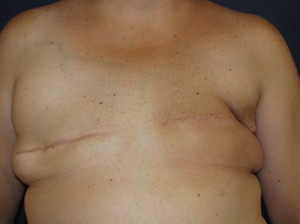
a.) Bilateral mastectomy and left breast irradiation. Preoperative
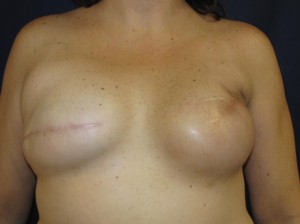
b.) Postoperative insertion and inflation of tissue expanders
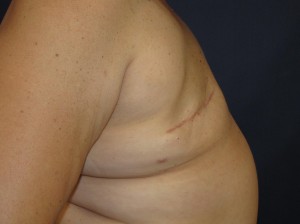
c.) Preoperative
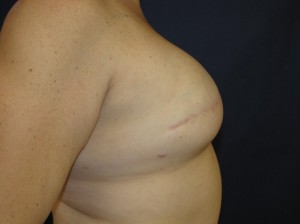
d.) Postoperative
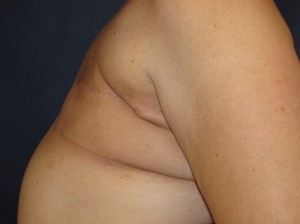
e.) Preoperative
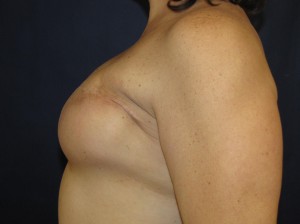
f.) Postoperative
Identical tissue expanders were inserted on both sides with the radiated side requiring a greater amount of inflation to reach what appears to be a less substantial sized mound. This is a clear manifestation of the effects of radiation on the tissues.
If you have some questions with regards to breast reconstruction, breast implants or any other plastic surgery procedure that I perform or if you would like to schedule a consultation with me, you can contact my office at 480-451-3000.
Steven H. Turkeltaub, M.D. P.C.
Scottsdale and Phoenix, Arizona