• Home
  • Blogs Home

Archive for the ‘Breast cancer’ Category

The Effects of Previous Unilateral Breast Radiation Treatments On Bilateral Breast Reconstruction Using Tissue Expanders

Sunday, December 27th, 2009

Women who undergo bilateral breast reconstruction have the best possible chance of obtaining relatively symmetrical results. This would be independent of the technique employed, whether it is immediate insertion of implants, utilization of tissue expanders or flap procedures such as a TRAM flap.

A significant exception to this would be unilateral radiation treatments as adjunct therapy for breast cancer. As I described in a previous post (Tissue Expansion for Breast Reconstruction Can Be Challenging In Women With Previous Radiation Therapy), radiation treatment causes permanent damage to the skin and underlying tissues resulting in scarring, thickening and rigidity often with some associated change of skin color and texture. It does impede the ability to stretch the skin as is required for breast reconstruction using tissue expanders and will substantially affect the final outcome.

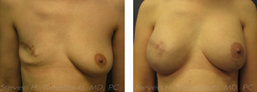
The following patient of mine exemplifies this effect. She underwent a bilateral mastectomy and unilateral radiation treatments on the left side. This converted a situation that could have provided her with relatively symmetrical results to one in which this was an impossibility. The method of breast reconstruction that she chose was to use tissue expanders.

a.) Bilateral mastectomy and left breast irradiation. Preoperative

b.) Postoperative insertion and inflation of tissue expanders

c.) Preoperative

d.) Postoperative

e.) Preoperative

f.) Postoperative

Identical tissue expanders were inserted on both sides with the radiated side requiring a greater amount of inflation to reach what appears to be a less substantial sized mound. This is a clear manifestation of the effects of radiation on the tissues.

If you have some questions with regards to breast reconstruction, breast implants or any other plastic surgery procedure that I perform or if you would like to schedule a consultation with me, you can contact my office at 480-451-3000.

Steven H. Turkeltaub, M.D. P.C.
Scottsdale and Phoenix, Arizona

Tags: Breast, Breast cancer, expanders, expansion, reconstruction, tissue
Posted in Breast cancer, Breast reconstruction, Tissue expanders, radiation treatments | Comments Off

A Small Percentage of Breast Reduction Specimens Contain Cancer Not Detected By Mammogram

Friday, October 30th, 2009

Most patients undergoing a breast reduction should have a fairly recent mammogram prior to surgery if they are past a certain age. The reason for this is that if any abnormal findings are detected that need further delineation, they should be pursued before proceeding with the planned breast reduction. A finding of breast cancer would preclude the need and indication for a breast reduction as this would be an inadequate treatment for breast cancer.

It would be ideal if mammograms could detect all occurrences of breast cancer but they do not. A fairly small percentage of breast cancers as well as pre-malignant lesions do escape detection but can be identified pathologically – from the specimen. This is why all breast tissue that is removed by the procedure is assessed by a pathologist.

A few studies have been performed over the years to determine the exact incidence of these “occult” breast cancers that can only be identified pathologically. The results indicate that the percentage is around 0.16% to 0.40% or up to 4 cases per thousand women. Nevertheless, these women are very fortunate because the early identification of their tumors translates into extremely high cure rates. If not for their initial desire for a breast reduction, they might not have had these cancers detected until a much later date at which point the prognosis would not be nearly as favorable.

The following patient exemplifies this scenario. She was a 39 year old woman wearing a 34G bra seeking a breast reduction. There were no abnormal detected masses on breast examination, her mammogram was unremarkable and there was no family history of breast cancer. Despite this, the breast tissue sent for pathological evaluation revealed the presence of early breast cancer.

Her treatment then consisted of bilateral mastectomies with immediate breast reconstruction. The photos below included her preoperative appearance, immediately following her breast reduction and then the final results after reconstruction.

Before Breast Reduction - Frontal View

Before breast reduction - Frontal view

Before Breast Reduction - Side View

Before breast reduction - Side view

Immediately following breast reduction - frontal view

Immediately following breast reduction - frontal view

Immediately following breast reduction - Side view

Immediately following breast reduction - Side view

Breast Reconstruction AP bra

After breast reconstruction - in bra

After breast reconstruction - Frontal view

After breast reconstruction - Frontal view

After breast reconstruction - Oblique view

After breast reconstruction - Oblique view

After breast reconstruction - Oblique view in bra

After breast reconstruction - in bra

Following breast reconstruction - Side view

Following breast reconstruction - Side view

Following breast reconstruction - Side view in bra

Following breast reconstruction - in bra

If you would like more information on breast reduction, breast reconstruction, information on any other cosmetic surgery procedure or to schedule a complimentary consultation, you can contact my office at 480-451-3000.

Steven H. Turkeltaub, M.D. P.C.
Scottsdale and Phoenix, Arizona

Tags: Breast cancer, Breast reduction, mammogram, reconstruction
Posted in Breast cancer, Breast reconstruction, Breast reduction | Comments Off

Tissue Expansion for Breast Reconstruction Can Be Challenging In Women With Previous Radiation Therapy

Sunday, August 23rd, 2009

Though radiation therapy is important in many situations for the treatment of breast cancer, it does present a challenge for breast reconstruction. Its permanent effects on the tissues of the chest can be significant and will have some impact on the reconstructive results.

The ionizing radiation injures and destroys healthy cells leading to scarring, thickening and rigidity of the tissues often with some associated change of color and texture. The outcome is skin and underlying tissues that feel firm, somewhat rigid and more resistant to stretching which is required for breast reconstruction using tissue expansion. In addition, nutritional blood flow to the area exposed to the radiation is significantly decreased due to permanently injured blood vessels. The consequences of this are an increased risk of infection, prolonged healing times from surgery and injury and greater susceptibility to trauma.

Because of these manifestations of radiation, it is not uncommon to be unable to stretch the tissue out to the predetermined volume and it definitely requires more time and patience. Infections are more common as is the incidence of capsular contracture, the formation of additional restricting scar tissue that further limits expansion. Incisions take much longer to heal and may reopen during the expansion. The tissue expanders not infrequently erode through the skin requiring an immediate surgical response.

Breast reconstruction employing tissue expanders in previously irradiated tissue can be successful but the risks and challenges should be understood as well as other options that may be available.

If you would like additional information on breast reconstruction or any other surgical procedure or to schedule a consultation, you can contact my office at 480-451-3000.

Steven H. Turkeltaub, M.D. P.C.
Scottsdale and Phoenix, Arizona

Tags: Breast, expander, Glendale, radiation, reconstruction, Scottsdale, tissue
Posted in Breast cancer, Breast reconstruction, Tissue expanders | Comments Off

Do Silicone Breast Implants Lower Your Risk for Developing Breast Cancer?

Sunday, May 24th, 2009

You must be thinking that there has to be a typo here. If anything, from all the news media palaver in the past, it is the opposite that must be true. Actually, this is the right question and it does have an unexpected answer.
Silicone breast implants have been subjected to more scrutiny and studies over the years than any other medical device. Several of these looked at any possible association of the long term presence of silicone breast implants with the development of breast cancer by evaluating large numbers of women over many years. The results were shocking but consistent: there is a statistically lower risk of developing breast cancer in women who have had these implants long term. This finding has been reconfirmed by many studies in diverse locations around the world.

The most recent research published in January 2009 in the International Journal of Cancer revealed the results of a epidemiological study of over 6200 Swedish and Danish women who had a mean duration of implantation of over 16.5 years with thirteen percent having them in excess of twenty five years. The findings identified a statistically significant reduction of risk of developing breast cancer of 27%. Previous studies conducted in the United States have shown decreased risks as high as 37 to 53%.

Why women with silicone breast implants have a lowered risk of developing breast cancer is unclear and has been the subject of much conjecture. However, this is fantastic news both for women who are considering a breast augmentation and those who already have silicone implants. When discussing breast enlargement with my patients, I try to put this all in perspective. I do not tell them that if they elect to have silicone breast implants, their risk for breast cancer may be decreased. Instead, I let them know that at a minimum there is no evidence that having silicone breast implants will increase their chances for developing breast cancer.

Steven H. Turkeltaub, M.D P.C.
Scottsdale and Phoenix, Arizona

Posted in Breast augmentation, Breast cancer, Breast implants, silicone implants | Comments Off

  • You are currently browsing the archives for the Breast cancer category.

  • Site Navigation

    • About Dr. Turkeltaub
    • Our Practice
    • Breast Augmentation
    • Breast Lift
    • Breast Revision Surgery
    • Breast Reduction
    • Male Breast Reduction
    • Breast Reconstruction
    • Maps & Directions
    • Financing
    • Contact Us

  • Recent Posts

    • Discomfort Following Male Breast Reduction Surgery For Gynecomastia Is Often Fairly Mild
    • Common Reasons For Undergoing Breast Implant Exchange Surgery
    • Dr. Steven Turkeltaub Has Been Selected As One Of America’s Top Plastic Surgeons for 2009
    • The Effects of Previous Unilateral Breast Radiation Treatments On Bilateral Breast Reconstruction Using Tissue Expanders
    • An Uncommon Outcome From Breast Augmentation: Symmastia (Uniboob)
    • A Small Percentage of Breast Reduction Specimens Contain Cancer Not Detected By Mammogram
    • Gynecomastia Treatment Scottsdale
    • Tissue Expansion for Breast Reconstruction Can Be Challenging In Women With Previous Radiation Therapy
    • Simple Steps to Lower the Risk of a Hematoma in Breast Augmentation Surgery
    • Breast Reductions Can Be Performed for Cosmetic Reasons
  • Categories

    • Breast augmentation (7)
      • symmastia (1)
    • Breast cancer (4)
      • radiation treatments (1)
    • Breast implants (5)
      • saline implants (1)
      • silicone implants (3)
    • Breast reconstruction (3)
      • Tissue expanders (2)
    • Breast reduction (4)
    • Insurance (1)
    • liposuction (1)
    • Male breast reduction (treatment of gynecomastia) (3)
    • Mastopexy (1)
    • News / Press (1)

www.arizonabreast.com/blog
Copyright © 2009 Steven H. Turkeltaub M.D.
10290 N. 92nd Street #304 Scottsdale AZ, 85258