
Bookmark This Page

Scottsdale Plastic Surgeon Discusses Breast Pills for Your Breast Enlargement

Enlarge your breasts two cup sizes in 90 days with our new, amazing breast growth tablets. There is no pain. No greasy lotions to stain your clothes. You don’t have to suffer the embarrassment of getting caught while rubbing some cream on your breasts that must be applied six times a day. No dangerous chemicals to mix. And best of all – there are absolutely no side effects.

Just larger, fuller, firm, voluptuous, and sexy breasts. Like you always dreamed about.

Your friends in Scottsdale, Phoenix, Glendale, Mesa and even Chandler and Gilbert will be astonished at the new, improved shapely You but no one will know your secret but You! And it’s permanent (provided you continue with my inexpensive maintenance pack).

There is no need for risky breast enlargement surgery. Say “no thanks” to those dangerous breast implants.

No! No! No! No! You don’t want those fake, manufactured things in YOUR body!

Plastic surgeons will be outraged … but you can laugh, look great and not have to pay those exorbitant surgical fees. And best of all: avoid surgery!

How is this possible?

It can’t be true, can it?

I, myself, never thought it possible that some rare and exotic herb could have such beneficial effects. Being highly skeptical, I hiked deep into a remote region of the Amazon to visit a primitive tribe I heard about where all the women were at least a “D” cup. Even more amazing, as I subsequently learned, was that their breasts remained firm and youthful well into their 50’s – even after several pregnancies and breast feeding.

What is their “secret”?

The answer is a diet rich in a leafy plant that only the women eat. It’s an herb that is found nowhere else on the planet.

Until now.

So if you want your breasts to grow bigger the natural way, without the risks and pain of breast augmentation surgery, you don’t have to go to the Amazon rainforest to obtain this amazing herb. I’ve brought it back for you in my safe, all natural proprietary formulation.

So hurry now and take advantage of this introductory, discounted limited time offer! You can get 100 of these amazing, patented breast pills for the easy low price of $89.99 plus S & H. And for the first 1000 callers, I will throw in a second bottle at no charge.  You just pay the additional S & H.

To place your order now, just call 800-TIT-PILLS (or 800-848-7455). Operators are standing by 24 hours a day.

If you call in the next 60 minutes, we will include for free in your order, 25 tablets for your man that contain another tropical herb that will help to further extend his interest in you …

Do you really believe advertisements like this touting incredible pills, tablet, or lotions guaranteed to enlarge your breasts or your man’s manhood?

Hopefully not, as they don’t exist!

These scams only serve to enlarge the bank accounts of the con artists promoting their quack medications and formulations. As the old adage goes: “If it sounds too good to be true, it probably is.”

If you would like some information on the real thing, breast augmentation surgery, or for any other plastic surgery procedure that I perform or to schedule a consultation with me, please call my office at 480-451-3000.

Steven H. Turkeltaub, M.D. P.C.
Scottsdale and Phoenix, Arizona

Breast Augmentation and “Natural” Looking Breasts

“Natural” looking breasts.

Over the years, many thousands of women have seen me in consultation for their breast augmentation. When sharing their goals to me, a majority of them invariably requested that they wanted their breasts to look “natural”. Then they proceeded to describe these desired outcomes that were in reality not so very “natural”. What might be “natural” to one woman would not be very satisfactory to another who was also looking for that “natural” result. Furthermore, many women just use the term but haven’t really thought about what it means to them except that it doesn’t include obscenely big.

What are natural looking breasts?

Are they a so called “C” cup or a “D” cup? Or even a “B” cup for the very petite? And which company’s bra will be the standard to make that determination?

Are they somewhat round, broad and with moderate projection? Or are they more projecting and less wide?

Is a tear drop shaped breast more natural or more desirable than a smooth and round one?

I could go on but you get the gist. Though it may give some people the warm and fuzzies, the use of “natural” together with breast implants and breast augmentation is not a very useful, descriptive or precise term. The one thing that it does convey is that the woman does not want to be grotesquely large (whatever size that may be!).

“Natural”, like beauty, is in the eyes of the beholder. When you are seeking to have a breast augmentation, know exactly what it is that you want and if you still insist on using the term “natural”, explain to your plastic surgeon exactly what that means to you. This includes such considerations as relative cup size, proportionality, cleavage, roundness, fullness, etc. Providing some photos showing women both in more revealing clothes and naked can be helpful to convey your thoughts.

If you don’t express exactly what it is that you want from your breast augmentation, there is a greater chance that you might not be entirely satisfied with the outcome.

For more information on breast augmentation surgery, breast implants or for any plastic surgery procedure that I perform, or to schedule a consultation with me, please call my office at 480-451-3000.

Steven H. Turkeltaub, M.D. P.C.
Scottsdale and Phoenix, Arizona

Do American Women Need to be Worried About the PIP Silicone Breast Implant Debacle?

A French manufacturer of breast implants, Poly Implant Prosthese (PIP), has been in the news worldwide and for all the wrong reasons.

Inferior quality breast implants that break easily.
Usage of unauthorized, non-medical grade silicone in their silicone implants.
Poor quality control and manufacturing techniques.
Concern that their implants may be associated with an increased incidence of cancer.
And now there are allegations that a fuel additive, untested in any human trials, was used in these implants.

These issues show an egregious violation of standards, ethics and integrity. On top of this, European medical regulatory agencies and other government agencies failed to protect the consumer.

Women in numerous countries around the world who had these implants used for their breast enlargement are quite understandably in a panic. There may be hundreds of thousands of them.

What about American women? Do they have anything to worry about here? How many of these implants were used in the United States?

Fortunately, the answers to these questions are both easy and positive.

PIP sold only saline implants in the United States for a short period of time – between the end of 1996 and 2000. In their investigation of the company and its saline implants, the FDA (Federal Drug Administration) in 2000 cited numerous issues and concerns including quality control problems and the unacceptably high deflation rate. This led to PIP immediately withdrawing these implants from the United States market.

And now for even better news: No PIP silicone implants were ever legally sold or used in the United States. Therefore, despite the worldwide uproar and concerns about these disastrous PIP silicone breast implants, American women don’t have to worry about this issue because they were never available for implantation here.

If you would like to obtain information on silicone breast implants, breast augmentation surgery or for any other plastic surgery procedure that I perform, or to schedule a consultation with me, please call my office at 480-451-3000.

Steven H. Turkeltaub, M.D. P.C.
Scottsdale and Phoenix, Arizona

Can One’s Body Really “Swallow” a Breast Implant?

A few days ago, there were countless headlines and stories in the media about a woman whose breast implant was “swallowed” by her body while doing Pilates. These were in response to a medical report documenting an unusual case that was just published in the Dec. 15th issue of the New England Journal of Medicine.

These reports garnished quite a lot of attention and also provoked some anxiety, concern and questions particularly in some women who already have breast implants. They want to know: “Is there a risk that the body can really “swallow” a breast implant?”

This case report involved a 59 year old woman who had previously undergone a bilateral mastectomy for breast cancer and had reconstruction with breast implants. During a Pilates stretching exercise, her right breast implant … disappeared. Gone in a flash! No external trace. She experienced no symptoms such as pain or shortness of breath.

A medical evaluation was performed including obtaining an ultrasound, chest X-ray and CT scan. What was discovered was that her intact breast implant was in her right chest cavity. It had been sucked into it during her stretching exercise.

She was taken to surgery during which the implant was extracted from the chest cavity and repositioned on the chest wall again where it belonged. A defect between the ribs which had allowed the implant to be displaced, was repaired. And she lived happily ever after. (Well, I don’t exactly know about that!)

So how did this bizarre situation occur?

This was the result of a confluence of issues and factors that together created the “perfect storm” for this rarity. The patient already had weak, flexible ribs. Her implants were not very large. And most importantly and what wasn’t clearly disclosed: she recently had undergone a mitral valve (a heart valve) replacement for a leaky heart valve and the approach used to access the heart was between the same two ribs that the implant slid between. The normal anatomy was disrupted by the surgery and a significant defect remained between these two ribs. Now, add to all of this a stretching maneuver that separated the ribs and created a negative force and, voilà, her breast implant was sucked into the chest cavity.

As you can see, the odds of this happening are less than being struck by lightning or winning the lottery. It is about on par with the probability of Obama suddenly becoming an adherent of conservative policies and slightly higher that the likelihood of taking a snapshot of the Loch Ness monster frolicking with its family or eating lunch with the Abominable snowman.

There are more important things to worry about in life.

Steven H. Turkeltaub, M.D. P.C.
Scottsdale and Phoenix, Arizona

Arizona Plastic Surgeon Reflects Statistics on Breast Augmentation

plastic, surgeon, surgery, breast, augmentation, implant, phoenix, scottsdale, az

Arizona Plastic Surgery Practice Reflects ASAPS Statistics

Of the more than 9.3 million cosmetic enhancement procedures performed in 2010, breast augmentation was the most common form of surgical enhancement according to the latest study from the American Society for Aesthetic Plastic Surgery (ASAPS). As a board-certified plastic surgeon in Phoenix, AZ, Dr. Steven Turkeltaub says the same is true at the Arizona Center for Breast Surgery.

According to the latest study from the American Society for Aesthetic Plastic Surgery (ASAPS), breast augmentation was the most common cosmetic plastic surgery procedure in 2010, followed by liposuction, eyelid surgery, abdominoplasty, and breast reduction. Dr. Steven Turkeltaub says that this is consistent with the breast surgery procedures that he performed for his patients in 2010 as well as the first half of 2011 at his Arizona plastic surgery practice.

Nearly 580,000 breast surgery procedures were performed in 2010. This total represents a 9% increase over the 2009 totals, which were adversely affected by the recession. However, Dr. Turkeltaub says this increase is due to more than the improved financial conditions: “As highlighted by the latest ASAPS study, an ever greater percentage of Americans approve of cosmetic enhancements, which are increasingly considered as mainstream procedures. In addition to wanting to look better—and feel better about themselves—as they have in the past, for some patients seeking employment or trying to hold on to their jobs, they believe a more youthful, attractive, and even alluring appearance may just provide them with a noticeable and competitive advantage.”

Regardless of the slight decrease in 2009, a 14-year comparison of breast augmentation reveals the number of procedures performed more than tripled from 101,176 in 1997, to 318,123 in 2010. Dr. Turkeltaub says the constant drive for innovation in the field of aesthetic enhancement is likely the cause of such a increase. “During this same period, there have been technological advancements as well as refinements in technique that should provide patients with more predictable and durable results along with even greater safety and comfort.”

About Steven H. Turkeltaub, MD, PC

Dr. Steven Turkeltaub earned his medical degree from Boston University School of Medicine. He completed his general and plastic surgery residencies at the University of Massachusetts Medical Center, where he also held an appointment as a Clinical Instructor. Dr. Turkeltaub has authored several papers and chapters for plastic surgery textbooks, as well as several magazines and newspapers. He is a member of the American Society of Plastic Surgeons, the Arizona Society of Plastic and Reconstructive Surgeons, and the Arizona Medical Society.

The Arizona Center for Breast Surgery has two locations: the Scottsdale office is located at 10290 N. 92nd St. Ste. 207 in Scottsdale, AZ 85258; and the Glendale office located at 18275 N. 59th Ave. Bldg. E Ste. 126 in Glendale, AZ 85308. Both locations can be reached at (480) 451-3000, or found online at arizonabreast.com or the Plastic Surgery Arizona Facebook page.

###

Silicone Breast Implants and the Cost Effectiveness and Accuracy of MRI’s to Screen for Rupture

As a result of research and technological advancements, there have been fundamental improvements in the design and construction of silicone breast implants over the years. These have translated into breast implants filled with a cohesive gel (like taffy) that are stronger, far more durable and resistant to a multitude of forces and factors and which will last considerably longer compared to previous generations of implants. They will not, however, necessarily last forever.

In 2006, the FDA issued recommendations (not a mandate) that women who have silicone breast implants as a results of breast augmentation or breast reconstruction should have an MRI starting three years after their surgery and then every other year subsequently. However, there was no scientific data to support this approach. Given the considerable expenses (and inconvenience) incurred by having these MRI’s which may not even be covered by insurance, we need to consider whether the FDA’s recommendations are really a prudent and necessary.

Research conducted at the University of Michigan and published in the March 2011 issue of the Plastic and Reconstructive Surgery® journal provides some compelling answers to this issue. This research combined and analyzed 21 previous studies that assessed the ability of MRI’s to detect silicone breast implant rupture in order to arrive at their conclusions.

What they discovered was that the MRI’s overall were fairly accurate in detecting ruptured silicone breast implants. However, in certain situations their accuracy rate was extremely high. In fact, they discovered that in women who presented with symptoms related to their breast implants, the MRI’s were 14 times more likely to discern a rupture than in those women who had no symptoms. Thus, in women who were asymptomatic, they were far less helpful.

How can we use this information to formulate reasonable recommendations?

Given that silicone gel breast implants will last on average well in excess of 10 years, MRI’s are not a cost effective tool to screen for ruptured breast implants in otherwise asymptomatic women during this first decade. Instead, mammograms and/or ultrasounds should be performed. If evidence arises or there is a significant index of suspicion for rupture, an MRI can then be considered.

If you would like more information on silicone gel breast implants, breast augmentation, breast reconstruction or for any other plastic surgery procedure that I perform or to schedule a complimentary consultation, please call my office at 480-451-3000.

Steven H. Turkeltaub, M.D. P.C.
Scottsdale and Phoenix, Arizona

What’s the Story on the “Gummy Bear” Breast Implants?

The term “gummy bear” breast implants has been used in the public realm for several years now yet most people know little about them. What they have heard is that they are the latest type of silicone breast implant and something that they may just want to have for their breast augmentation or breast reconstruction.

You might have wondered: “Exactly what are these breast implants and why are they named after a candy?”

You may even be thinking: “Can I have them for my surgery?”

“Gummy bear” implants are a new generation of silicone breast implants that have some of the characteristics of the candy that they were nicknamed after – though they are not also edible! These implants differ from all earlier versions in that they are composed of a very highly cohesive and form-stable (maintains their shape) gel that resembles the candy though softer.

These 5th generation breast implants have been used elsewhere around the world for breast augmentations and reconstructions since the early 1990’s. They have been extensively researched for years including in large clinical trials but have not yet been cleared by the FDA (Federal Drug Administration) for usage here in the United States although approval may be imminent. (Note: Plastic surgeons here in the United States have been hearing this for several years now – and we are still waiting!)

These new silicone breast implants do offer at least a few advantages over the current cohesive silicone gel ones (as well as some disadvantages). They have been noted to be more durable and last longer and the potential of the silicone gel migrating elsewhere is close to zero. The risk of developing hardness around the implants known as capsular contracture has been found to be lower, around an incidence of 3% as compared to 5 – 10% or more with previous generations of silicone implants.

A definite disadvantage of these “gummy bear” implants is the cost which is expected to be significantly more expensive than those that are used now. Whether this difference is an additional several hundred dollars or much more is not known as of yet. Their increased cost will definitely have some effect on their popularity and selection. Ultimately, however, several factors will play a role in influencing each woman’s decision regarding which type of silicone breast implant is right for her.

For more information on silicone gel breast implants, breast augmentation surgery or for any other plastic surgery procedure that I perform or to schedule a consultation with me, please call my office at 480-451-3000.

Steven H. Turkeltaub, M.D. P.C.
Scottsdale and Phoenix, Arizona

FDA Issues Report on Extremely Rare Occurrence of ALCL In A Few Women With Breast Implants

The Federal Drug Administration (FDA) just issued a press release regarding the appearance of a very rare type of cancer that has been found in some women who have either saline or silicone breast implants. In these women, anaplastic large-cell lymphoma (ALCL) has been identified in the capsule (scar tissue) that forms around breast implants along with the accumulation of fluid known as a seroma. Despite these few cases, there is no evidence that there is any direct cause and effect and so more studies will need to be conducted to determine whether or not there is any relationship.

ALCL is extremely rare in general with an annual incidence in this country of 1 out of every 500,000 women. The rate of occurrence with the primary location in the breast is an infinitesimally microscopic 3 in 100,000,000 women per year. Worldwide, there have been somewhere between 34 and 60 cases of this disease out of an estimated total of 10 million or more women who have had breast implants.

How insignificant is this? The average annual risk of developing primary breast cancer in American women is 123 per 100,000 which is equivalent to 123,000 cases per 100 million women. This translates to a risk that is 41,000 times more common than ALCL.

The form of ALCL that has been identified in women who also have breast implants is a relatively “benign” disease that presents with a consistent constellation of symptoms that can facilitate the diagnosis once a level of suspicion is raised. These findings include the onset of pain in the affected breast associated with a mass and a rapid increase in size as a consequence of the accumulation of fluid. The median time of occurrence of ALCL following the placement of breast implants is 8 years.

Once the diagnosis is made, treatment is straightforward and curative with no need for chemotherapy or radiation therapy. The cure is simply the removal of the scar tissue (capsule) that surrounds the implant which is the location of the disease. Some of the affected women actually had new implants reinserted without untoward consequence though studies will need to be performed to determine the advisability of this. Importantly, there have never been any report of death associated with ALCL.

To sum up the findings of anaplastic large-cell lymphoma (ALCL) with regards to breast implants:

  1. no association has been firmly established between the disease and either saline or silicone breast implants
  2. the constellation of presenting symptoms can make the diagnosis of this relatively easy with a level of suspicion
  3. the disease is quite benign and completely cured with surgical removal of the capsule surrounding the breast implant
  4. there is no need for chemotherapy or radiation therapy
  5. no deaths have been reported

For more information on ALCL, you can read the FDA’s report as well as visit the American Society of Plastic Surgeons website.

If you have any questions regarding this issue or on any cosmetic or reconstructive breast surgery or other plastic surgery procedure that I perform, please feel free to call my office at 480-451-3000. You can also schedule a complimentary consultation at that time.

Steven H. Turkeltaub, M.D. P.C.
Scottsdale and Phoenix, Arizona

Silicone Breast Implants Are The Overwhelming Implant Preference of Women

For any breast procedure requiring the placement of breast implants, my patients are offered the option of using either silicone or saline implants. This would include women who are considering breast augmentation, breast lift with implants, breast implant exchange and breast reconstruction. I thoroughly discuss with them all the important and relevant information about these two types of implants such as appearance, feel, durability, aesthetics, rupture, risks and possible areas of concern. They also are able to touch and closely examine both the silicone and saline implants.

What have I found is the overwhelming majority of my patients select the silicone implants for both cosmetic and reconstructive procedures and they definitely don’t regret the choice. The aesthetic results and much higher level of satisfaction irrefutably support the substantially greater superiority of silicone implants as compared to the saline ones. This is true for both cosmetic and reconstructive procedures. In my practice it is quite rare now for a woman to opt for saline implants and when they do it is virtually always because they cost $1,000 less a pair which then makes the cosmetic surgery affordable.

This finding is consistent with the medical literature including research just published in the November issue of “Cancer”. This multicenter study examined and analyzed the responses obtained from 672 women who had post-mastectomy (for breast cancer) breast reconstruction utilizing either silicone or saline implants. The results revealed a statistically significant greater level of satisfaction in women who chose the silicone breast implants for their reconstruction as opposed to the saline ones.

So, if you are interesting in pursuing either a cosmetic or reconstructive breast procedure that involves the usage of breast implants and were initially leaning toward saline implants you may want to strongly reconsider.

For additional information on silicone or saline breast implants, breast augmentation, breast reconstruction or for any other plastic surgery procedure that I perform or to schedule a consultation, please call my office at 480-451-3000.

Steven H. Turkeltaub, M.D. P.C.
Scottsdale and Phoenix, Arizona

When Are Breast Implants Indicated With a Mastopexy?

A mastopexy is the surgical procedure that addresses droopy breasts by tightening the skin, recontouring the shape, and lifting the tissues to create a more youthful appearance. Without the insertion of breast implants, the results may be breasts that are more normal in shape than before but often smaller than expected by the individual which can lead to some disappointment.
When, then, should you consider implants be for your mastopexy? The answer to this is not very difficult most of the time. If you feel that your drooping breasts now are smaller than you would like them to ultimately be, then undergoing a breast augmentation along with the breast lift should allow you to achieve the desired enlarged size. Conversely, if your breasts presently are much larger than you want them to be, there would be no need for implants. Instead, a reduction in size by removing breast tissue would be appropriate.

It is somewhere in between these two “extremes” that determining whether or not to insert breast implants may not be entirely obvious. This decision is also based on the facts that a mastopexy involves the removal of at minimum a small amount of breast tissue and compacts the volume of what remains, most women desire more volume at the upper part of their breasts (a push-up look) and most women would prefer to be a little bigger than a little smaller.

I have found that a vast majority of my patients who undergo a mastopexy also have a concurrent breast augmentation. Even a relatively small breast implant may create a firmer, fuller, rejuvenated appearance with improved cleavage that can be quite alluring.

For more information on a mastopexy, breast augmentation, breast implants or on any other plastic surgery procedure that I perform or to schedule a complimentary consultation with me, please call my office at 480-451-3000.

Steven H. Turkeltaub, M.D. P.C.
Scottsdale and Phoenix, Arizona

Great Results Following Breast Augmentation Can Persist For Many Years

Women who have had breast augmentations are overwhelming satisfied with their decision with 94% stating that they would definitely make the same choice again. Their breast enhancement has had positive effects not only their appearance but also on their mental and emotional well being. An interesting question that is not often asked is how well these physical results hold up over time.

In the years that follow their breast augmentations, many women will have significant weight fluctuations or even permanent weight gains. Surely, there must be an effect on the breast size, appearance, etc. and there is. Even with sizable weight gains, persistence of good results can be possible. Pregnancy and breast feeding, on the other hand, can be quite detrimental to the elasticity of the skin as well as to the inherent density and volume of breast tissue resulting in drooping that may need to be addressed with a breast lift. However, with the presence of breast implants, significant volume and shape can still be maintained.

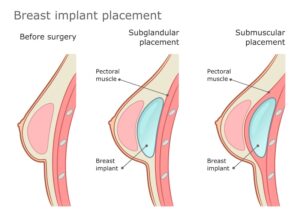
I have been fortunate enough to have seen many of my breast enlargement patients who had their surgery ten to twenty or more years previously. From this follow up, it is clear that a majority still have aesthetically pleasing improvements even despite marked weight gains. It should be pointed out that virtually all of the breast enlargements that I performed had the breast implants inserted in a submuscular pocket where there is better long term support against gravity. Implants that have been placed in a submammary pocket generally don’t do nearly as well over time because of the far greater drooping that will occur.

Before breast augmentation - front view

Before breast augmentation - side view

4 months after breast augmentation - frontal view

4 months after breast augmentation - side view

8 years after breast augmentation and 40 pound weight gain - frontal view

8 years after breast augmentation and 40 pound weight gain - side view

If you have additional questions regarding breast augmentation, breast implants or any other cosmetic surgery procedure that I perform or to schedule a complimentary consultation, please call my office at 480-451-3000.

Steven H. Turkeltaub, M.D. P.C.
Scottsdale and Phoenix, Arizona

Common Reasons For Undergoing Breast Implant Exchange Surgery

Replacing of a woman’s own implants for newer ones is referred to as breast implant exchange surgery which also is a category of breast revision surgery. The implants could have been originally placed for a breast augmentation, during a breast lift or in breast reconstruction.

There are several reasons why a woman would select this course of action with some of the most common ones being to:

  1. change the size of the implant
  2. alter the shape with regard to projection and width
  3. change from saline to silicone implants or vice versa
  4. replace an implant which has ruptured
  5. change the implants as an incidental part of another breast issue such as drooping or capsular contracture

Usually the number one reason for a breast implant exchange is to obtain larger implants in order to have breasts that are significantly larger. Very uncommonly does a patient request going to a smaller size. In most of these situations, it is either because they were made excessively large initially by their surgeon or they gained a considerable amount of weight in the intervening period of time resulting in concomitant natural breast enlargement.

It is quite rare for my personal patients to desire different implant sizes and when they do, it is usually years later and often precipitated by another event such as an implant rupture. How is it that my implant exchange rate is very low? During my patient’s consultation, I listen carefully to their desires and concerns, take measurements, have them “try on” different implants as well as show them photographs of other patients that may be relevant for their situation. Finally, during surgery I will first use temporary “sizers” so as to precisely determine the perfect implant for them.

The relative proportions (profile) of the implant which affect the ultimate breast configuration, are also important. By explaining and offering different profile implants such moderate, high and super-high, my patients can realize the customized appearance they desire. For example, a patient who has a very narrow chest and wants a lot of projection but without excessive width, would benefit from a higher profile implant. A woman who is relatively broad, has a moderate amount of breast tissue and doesn’t want to be extremely large, would be better off with a moderate profile implant.

Finally, most of the patients that I see who have saline implants and are undergoing an exchange for whatever reason, switch to silicone implants. The reason is fairly obvious – they look and feel far more natural. Only in rare circumstances do they go from silicone to saline and it is never for aesthetic reasons.

For more information on breast implants, breast enlargement or any other plastic surgery procedure that I perform or to schedule a complimentary consultation, please contact my office at 480-451-3000.

Steven H. Turkeltaub, M.D. P.C.
Scottsdale and Phoenix, Arizona

An Uncommon Outcome From Breast Augmentation: Symmastia (Uniboob)

Though the results from a breast augmentation are generally excellent with a satisfaction rate well over 90 percent, complications and less than desirable results do occur. One of the less common problems that can occur is where the breasts are so close together that they seem to coalesce into one breast unit. This is called symmastia (or synmastia) or in pseudo lay terms, a uniboob.

Symmastia of breasts

Symmastia of breasts

What are the causes of this deformity known as symmastia? Usually this is the result of attempting to move the breasts closer together in order to obtain improved cleavage. The pockets for the implants are dissected too far toward the midline which detaches the skin and underlying tissue from adhering to the sternum. The skin then drapes over the breast implants without having a discrete attachment to the sternum creating this amorphous “uniboob”. The situation is further exacerbated with implants that are inappropriately sized for the woman’s dimensions. Symmastia can occur both with breast implants placed in front of and behind the pectoralis major (chest wall) muscle.

Women who are very thin do have a slightly greater risk of this deformity occurring as do those who have a chest wall deformity known as pectus excavatum (where the sternum has a caved in appearance). Very conservative dissection in these situations and avoiding disproportionately large breast implants can help to minimize the development of symmastia.

There are several approaches which have been employed to address this challenging deformity. A relatively new technique involving the placement of specially processed tissue (Alloderm® and Strattice®) offer the potential of more predictable, satisfactory and permanent results.

For more information on symmastia, breast implants, breast augmentation or any other cosmetic surgery procedure or to schedule a consultation, you can call my office at 480-451-3000.

Steven H. Turkeltaub, M.D. P.C.
Scottsdale and Phoenix, Arizona

What is the Earliest Age That A Breast Augmentation Should be Done?

In our society, there is a strong emphasis on breasts and breast size. From magazines, television, movies and even advertisements, there is a preponderance of voluptuous well-endowed women that are seen as the ideal. Their presence seemingly everywhere can be quite stressful for the adolescent girl experiencing considerable hormonal and emotional fluctuations and physical changes along with a fragile body image.

When an adolescent girl realizes that her breasts are not and will never be the size that she would like them to be, what is the youngest age that it would be reasonable for her to pursue breast augmentation surgery? Taking physical, emotional, and intellectual issues and maturation into consideration, my recommendation is for her to wait until at least 18 years of age before undergoing a breast enlargement.

As with many things, there are some exceptions. If a girl has breasts of such significantly different sizes that is difficult to hide with normal clothing or if there is either severe underdevelopment or absence of one breast (which is often congenital in nature), proceeding with surgery at an earlier age may be more prudent. Surgery in these situations may even be considered to be reconstructive.

If you would like additional information on breast augmentation, breast implants or other cosmetic procedures, you can contact my office at 480-451-3000.

Steven H. Turkeltaub, M.D. P.C.
Scottsdale and Phoenix, Arizona

Do Silicone Breast Implants Lower Your Risk for Developing Breast Cancer?

You must be thinking that there has to be a typo here. If anything, from all the news media palaver in the past, it is the opposite that must be true. Actually, this is the right question and it does have an unexpected answer.
Silicone breast implants have been subjected to more scrutiny and studies over the years than any other medical device. Several of these looked at any possible association of the long term presence of silicone breast implants with the development of breast cancer by evaluating large numbers of women over many years. The results were shocking but consistent: there is a statistically lower risk of developing breast cancer in women who have had these implants long term. This finding has been reconfirmed by many studies in diverse locations around the world.

The most recent research published in January 2009 in the International Journal of Cancer revealed the results of a epidemiological study of over 6200 Swedish and Danish women who had a mean duration of implantation of over 16.5 years with thirteen percent having them in excess of twenty five years. The findings identified a statistically significant reduction of risk of developing breast cancer of 27%. Previous studies conducted in the United States have shown decreased risks as high as 37 to 53%.

Why women with silicone breast implants have a lowered risk of developing breast cancer is unclear and has been the subject of much conjecture. However, this is fantastic news both for women who are considering a breast augmentation and those who already have silicone implants. When discussing breast enlargement with my patients, I try to put this all in perspective. I do not tell them that if they elect to have silicone breast implants, their risk for breast cancer may be decreased. Instead, I let them know that at a minimum there is no evidence that having silicone breast implants will increase their chances for developing breast cancer.

Steven H. Turkeltaub, M.D P.C.
Scottsdale and Phoenix, Arizona

Breast Implants in Breast Augmentation: How Long Do They Last?

If you have breast implants, don’t you wish that they would last forever? Although this would be wonderful, they are not lifetime devices and will probably need to be replaced sometime in the future. Many of my patients here in the Scottsdale, Glendale and the Phoenix area are under the impression that breast implants need to be replaced every ten years. Fortunately, this is not the case. The silicone gel implants manufactured today are much better than previous generations. There have been many technological and manufacturing improvements including a thicker and more durable outer shell that is virtually impermeable to any silicone migration.

They also are filled with a much more cohesive silicone gel. As a consequence, it is possible for many silicone gel breast implants to last 20 to 30 years or more. In an ongoing prospective scientific study overseen by one of the silicone implant manufacturers, Allergan, it was noted that there is a rupture rate of 2.7% at 4 years after breast enlargement surgery.

Saline breast implants deflate, on average, much earlier and at a significantly higher rate as compared to silicone implants. This has been borne out by my personal experience of over twenty years at the Arizona Center for Aesthetic Plastic Surgery. Textured saline implants do not fare nearly as well as the smooth surfaced ones.

There are many other factors that can influence the lifespan of the implants aside from whether they are silicone or saline. Some of these include the presence or absence of surface texturing, size of the implant, manufacturer of the implant, size and location of the incision for insertion, surgical technique, mammograms and trauma. Each one of these issues can be discussed in more detail during your consultation.

Breast enlargement is extremely rewarding for the vast majority of women who have had the procedure. Just realize that although the breast implants are generally quite durable, they typically will not last forever.

For much more information or to schedule a thorough consultation for a breast augmentation, breast lift with implants or other cosmetic procedures, you can contact Dr. Turkeltaub at 480-451-3000.

Smooth(left) and a textured(right) silicone implants

Smooth(left) and textured(right) silicone implants