
Bookmark This Page

Do American Women Need to be Worried About the PIP Silicone Breast Implant Debacle?

A French manufacturer of breast implants, Poly Implant Prosthese (PIP), has been in the news worldwide and for all the wrong reasons.

Inferior quality breast implants that break easily.
Usage of unauthorized, non-medical grade silicone in their silicone implants.
Poor quality control and manufacturing techniques.
Concern that their implants may be associated with an increased incidence of cancer.
And now there are allegations that a fuel additive, untested in any human trials, was used in these implants.

These issues show an egregious violation of standards, ethics and integrity. On top of this, European medical regulatory agencies and other government agencies failed to protect the consumer.

Women in numerous countries around the world who had these implants used for their breast enlargement are quite understandably in a panic. There may be hundreds of thousands of them.

What about American women? Do they have anything to worry about here? How many of these implants were used in the United States?

Fortunately, the answers to these questions are both easy and positive.

PIP sold only saline implants in the United States for a short period of time – between the end of 1996 and 2000. In their investigation of the company and its saline implants, the FDA (Federal Drug Administration) in 2000 cited numerous issues and concerns including quality control problems and the unacceptably high deflation rate. This led to PIP immediately withdrawing these implants from the United States market.

And now for even better news: No PIP silicone implants were ever legally sold or used in the United States. Therefore, despite the worldwide uproar and concerns about these disastrous PIP silicone breast implants, American women don’t have to worry about this issue because they were never available for implantation here.

If you would like to obtain information on silicone breast implants, breast augmentation surgery or for any other plastic surgery procedure that I perform, or to schedule a consultation with me, please call my office at 480-451-3000.

Steven H. Turkeltaub, M.D. P.C.
Scottsdale and Phoenix, Arizona

Silicone Breast Implants and the Cost Effectiveness and Accuracy of MRI’s to Screen for Rupture

As a result of research and technological advancements, there have been fundamental improvements in the design and construction of silicone breast implants over the years. These have translated into breast implants filled with a cohesive gel (like taffy) that are stronger, far more durable and resistant to a multitude of forces and factors and which will last considerably longer compared to previous generations of implants. They will not, however, necessarily last forever.

In 2006, the FDA issued recommendations (not a mandate) that women who have silicone breast implants as a results of breast augmentation or breast reconstruction should have an MRI starting three years after their surgery and then every other year subsequently. However, there was no scientific data to support this approach. Given the considerable expenses (and inconvenience) incurred by having these MRI’s which may not even be covered by insurance, we need to consider whether the FDA’s recommendations are really a prudent and necessary.

Research conducted at the University of Michigan and published in the March 2011 issue of the Plastic and Reconstructive Surgery® journal provides some compelling answers to this issue. This research combined and analyzed 21 previous studies that assessed the ability of MRI’s to detect silicone breast implant rupture in order to arrive at their conclusions.

What they discovered was that the MRI’s overall were fairly accurate in detecting ruptured silicone breast implants. However, in certain situations their accuracy rate was extremely high. In fact, they discovered that in women who presented with symptoms related to their breast implants, the MRI’s were 14 times more likely to discern a rupture than in those women who had no symptoms. Thus, in women who were asymptomatic, they were far less helpful.

How can we use this information to formulate reasonable recommendations?

Given that silicone gel breast implants will last on average well in excess of 10 years, MRI’s are not a cost effective tool to screen for ruptured breast implants in otherwise asymptomatic women during this first decade. Instead, mammograms and/or ultrasounds should be performed. If evidence arises or there is a significant index of suspicion for rupture, an MRI can then be considered.

If you would like more information on silicone gel breast implants, breast augmentation, breast reconstruction or for any other plastic surgery procedure that I perform or to schedule a complimentary consultation, please call my office at 480-451-3000.

Steven H. Turkeltaub, M.D. P.C.
Scottsdale and Phoenix, Arizona

What’s the Story on the “Gummy Bear” Breast Implants?

The term “gummy bear” breast implants has been used in the public realm for several years now yet most people know little about them. What they have heard is that they are the latest type of silicone breast implant and something that they may just want to have for their breast augmentation or breast reconstruction.

You might have wondered: “Exactly what are these breast implants and why are they named after a candy?”

You may even be thinking: “Can I have them for my surgery?”

“Gummy bear” implants are a new generation of silicone breast implants that have some of the characteristics of the candy that they were nicknamed after – though they are not also edible! These implants differ from all earlier versions in that they are composed of a very highly cohesive and form-stable (maintains their shape) gel that resembles the candy though softer.

These 5th generation breast implants have been used elsewhere around the world for breast augmentations and reconstructions since the early 1990’s. They have been extensively researched for years including in large clinical trials but have not yet been cleared by the FDA (Federal Drug Administration) for usage here in the United States although approval may be imminent. (Note: Plastic surgeons here in the United States have been hearing this for several years now – and we are still waiting!)

These new silicone breast implants do offer at least a few advantages over the current cohesive silicone gel ones (as well as some disadvantages). They have been noted to be more durable and last longer and the potential of the silicone gel migrating elsewhere is close to zero. The risk of developing hardness around the implants known as capsular contracture has been found to be lower, around an incidence of 3% as compared to 5 – 10% or more with previous generations of silicone implants.

A definite disadvantage of these “gummy bear” implants is the cost which is expected to be significantly more expensive than those that are used now. Whether this difference is an additional several hundred dollars or much more is not known as of yet. Their increased cost will definitely have some effect on their popularity and selection. Ultimately, however, several factors will play a role in influencing each woman’s decision regarding which type of silicone breast implant is right for her.

For more information on silicone gel breast implants, breast augmentation surgery or for any other plastic surgery procedure that I perform or to schedule a consultation with me, please call my office at 480-451-3000.

Steven H. Turkeltaub, M.D. P.C.
Scottsdale and Phoenix, Arizona

Silicone Breast Implants Are The Overwhelming Implant Preference of Women

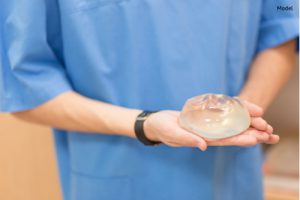
For any breast procedure requiring the placement of breast implants, my patients are offered the option of using either silicone or saline implants. This would include women who are considering breast augmentation, breast lift with implants, breast implant exchange and breast reconstruction. I thoroughly discuss with them all the important and relevant information about these two types of implants such as appearance, feel, durability, aesthetics, rupture, risks and possible areas of concern. They also are able to touch and closely examine both the silicone and saline implants.

What have I found is the overwhelming majority of my patients select the silicone implants for both cosmetic and reconstructive procedures and they definitely don’t regret the choice. The aesthetic results and much higher level of satisfaction irrefutably support the substantially greater superiority of silicone implants as compared to the saline ones. This is true for both cosmetic and reconstructive procedures. In my practice it is quite rare now for a woman to opt for saline implants and when they do it is virtually always because they cost $1,000 less a pair which then makes the cosmetic surgery affordable.

This finding is consistent with the medical literature including research just published in the November issue of “Cancer”. This multicenter study examined and analyzed the responses obtained from 672 women who had post-mastectomy (for breast cancer) breast reconstruction utilizing either silicone or saline implants. The results revealed a statistically significant greater level of satisfaction in women who chose the silicone breast implants for their reconstruction as opposed to the saline ones.

So, if you are interesting in pursuing either a cosmetic or reconstructive breast procedure that involves the usage of breast implants and were initially leaning toward saline implants you may want to strongly reconsider.

For additional information on silicone or saline breast implants, breast augmentation, breast reconstruction or for any other plastic surgery procedure that I perform or to schedule a consultation, please call my office at 480-451-3000.

Steven H. Turkeltaub, M.D. P.C.
Scottsdale and Phoenix, Arizona

Common Reasons For Undergoing Breast Implant Exchange Surgery

Replacing of a woman’s own implants for newer ones is referred to as breast implant exchange surgery which also is a category of breast revision surgery. The implants could have been originally placed for a breast augmentation, during a breast lift or in breast reconstruction.

There are several reasons why a woman would select this course of action with some of the most common ones being to:

  1. change the size of the implant
  2. alter the shape with regard to projection and width
  3. change from saline to silicone implants or vice versa
  4. replace an implant which has ruptured
  5. change the implants as an incidental part of another breast issue such as drooping or capsular contracture

Usually the number one reason for a breast implant exchange is to obtain larger implants in order to have breasts that are significantly larger. Very uncommonly does a patient request going to a smaller size. In most of these situations, it is either because they were made excessively large initially by their surgeon or they gained a considerable amount of weight in the intervening period of time resulting in concomitant natural breast enlargement.

It is quite rare for my personal patients to desire different implant sizes and when they do, it is usually years later and often precipitated by another event such as an implant rupture. How is it that my implant exchange rate is very low? During my patient’s consultation, I listen carefully to their desires and concerns, take measurements, have them “try on” different implants as well as show them photographs of other patients that may be relevant for their situation. Finally, during surgery I will first use temporary “sizers” so as to precisely determine the perfect implant for them.

The relative proportions (profile) of the implant which affect the ultimate breast configuration, are also important. By explaining and offering different profile implants such moderate, high and super-high, my patients can realize the customized appearance they desire. For example, a patient who has a very narrow chest and wants a lot of projection but without excessive width, would benefit from a higher profile implant. A woman who is relatively broad, has a moderate amount of breast tissue and doesn’t want to be extremely large, would be better off with a moderate profile implant.

Finally, most of the patients that I see who have saline implants and are undergoing an exchange for whatever reason, switch to silicone implants. The reason is fairly obvious – they look and feel far more natural. Only in rare circumstances do they go from silicone to saline and it is never for aesthetic reasons.

For more information on breast implants, breast enlargement or any other plastic surgery procedure that I perform or to schedule a complimentary consultation, please contact my office at 480-451-3000.

Steven H. Turkeltaub, M.D. P.C.
Scottsdale and Phoenix, Arizona

Do Silicone Breast Implants Lower Your Risk for Developing Breast Cancer?

You must be thinking that there has to be a typo here. If anything, from all the news media palaver in the past, it is the opposite that must be true. Actually, this is the right question and it does have an unexpected answer.
Silicone breast implants have been subjected to more scrutiny and studies over the years than any other medical device. Several of these looked at any possible association of the long term presence of silicone breast implants with the development of breast cancer by evaluating large numbers of women over many years. The results were shocking but consistent: there is a statistically lower risk of developing breast cancer in women who have had these implants long term. This finding has been reconfirmed by many studies in diverse locations around the world.

The most recent research published in January 2009 in the International Journal of Cancer revealed the results of a epidemiological study of over 6200 Swedish and Danish women who had a mean duration of implantation of over 16.5 years with thirteen percent having them in excess of twenty five years. The findings identified a statistically significant reduction of risk of developing breast cancer of 27%. Previous studies conducted in the United States have shown decreased risks as high as 37 to 53%.

Why women with silicone breast implants have a lowered risk of developing breast cancer is unclear and has been the subject of much conjecture. However, this is fantastic news both for women who are considering a breast augmentation and those who already have silicone implants. When discussing breast enlargement with my patients, I try to put this all in perspective. I do not tell them that if they elect to have silicone breast implants, their risk for breast cancer may be decreased. Instead, I let them know that at a minimum there is no evidence that having silicone breast implants will increase their chances for developing breast cancer.

Steven H. Turkeltaub, M.D P.C.
Scottsdale and Phoenix, Arizona

Breast Implants in Breast Augmentation: How Long Do They Last?

If you have breast implants, don’t you wish that they would last forever? Although this would be wonderful, they are not lifetime devices and will probably need to be replaced sometime in the future. Many of my patients here in the Scottsdale, Glendale and the Phoenix area are under the impression that breast implants need to be replaced every ten years. Fortunately, this is not the case. The silicone gel implants manufactured today are much better than previous generations. There have been many technological and manufacturing improvements including a thicker and more durable outer shell that is virtually impermeable to any silicone migration.

They also are filled with a much more cohesive silicone gel. As a consequence, it is possible for many silicone gel breast implants to last 20 to 30 years or more. In an ongoing prospective scientific study overseen by one of the silicone implant manufacturers, Allergan, it was noted that there is a rupture rate of 2.7% at 4 years after breast enlargement surgery.

Saline breast implants deflate, on average, much earlier and at a significantly higher rate as compared to silicone implants. This has been borne out by my personal experience of over twenty years at the Arizona Center for Aesthetic Plastic Surgery. Textured saline implants do not fare nearly as well as the smooth surfaced ones.

There are many other factors that can influence the lifespan of the implants aside from whether they are silicone or saline. Some of these include the presence or absence of surface texturing, size of the implant, manufacturer of the implant, size and location of the incision for insertion, surgical technique, mammograms and trauma. Each one of these issues can be discussed in more detail during your consultation.

Breast enlargement is extremely rewarding for the vast majority of women who have had the procedure. Just realize that although the breast implants are generally quite durable, they typically will not last forever.

For much more information or to schedule a thorough consultation for a breast augmentation, breast lift with implants or other cosmetic procedures, you can contact Dr. Turkeltaub at 480-451-3000.

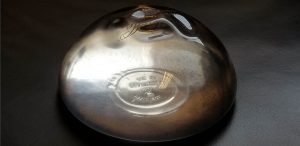
Smooth(left) and a textured(right) silicone implants

Smooth(left) and textured(right) silicone implants